Search This Blog

Showing posts with label SeaWorld. Show all posts

18 July 2024

Morgan Is Not The Only One Having Problems Hearing!


Loro Parque leads the way with study into the hearing of whales

Thursday, 13 November saw yet another judgment from the Dutch courts on the fate of the young female killer whale, “Morgan," who stranded on the Dutch coast in June 2010 and was rehabilitated by the group SOS Delfijn and employees from Dolfinarium Harderwijk. The animal was deemed unsuitable for release and was moved to live with a group of other killer whales at Loro Parque, Tenerife, Spain in November 2011.

12 August 2019

Killer whales, car parks and The Whale Sanctuary.

The entertainment website LAD Bible perpetuating pseudoscience rather than objective journalism

"...there is no evidence to suggest the size of zoo car park should determine the size of their animal exhibits…"

One of the arguments against having large animals in human care such as whales and dolphins is that in the wild these animals range over large areas. This is then presented juxtaposed to the habitats these animals are provided with within human care. 


One such animal-rights meme (promoted by the animal rights group the Orca Project) has been an aerial photograph of one of the SeaWorld parks comparing the killer whale habitat with the size of the car park and an ornamental lake. As always this is an appeal to emotion from the animal rights industry. Moreover, as regards animal welfare it is not valid, particularly when comparing the life of animals in the wild with those in human care.


First, there is the obvious observation that there is no scientific correlation between the size of a car park in a zoological collection with the size of the facilities needed for the successful care of the animals they exhibit. Further, such a comparison is erroneous because in the wild many animal species may travel long distances for two primary reasons: one is to forage for food and the other is reproduction. They have to undertake these behaviours as a matter of survival: they are not undertaking this for recreational reasons. 


In fact, research that looked into the provisioning (feeding) of wild animals actually demonstrates that these animals do not move away from the area where they are being fed. This is why many countries like the USA prohibit the feeding of wild animals by the public because it distorts their natural behaviour; makes animals dependent on humans for their food and it can compromise their welfare. A case in point is the wild dolphins living in Australia at Monkey Mai where provisioning of the animals by the public has caused serious problems as regards animals welfare.


Moreover, animals in human care are living in artificial environments and therefore the dynamics are different than the wild. They are dependent on their food from their caretakers which does not involve the animals having to travel long distances. Therefore, giving them environments to live in that reflect travelling distance when foraging for food in the wild serves no useful purpose.

This is not to say that in human care animals can be kept in any form of restricted environment but these considerations need to be objectively assessed. Again, using the travelling distances that animals need to forage in the wild is not an appropriate parameter. It should be noted that a number of countries including the United States, have specific legislation that regulates the parameters of care that animals must be given. 


The Whale Sanctuary Project and their need for animals.


Perhaps it's worth considering why the animal rights industry is taking so much time and trouble with these kinds of campaigns. 


Originally, SeaWorld was going to extend their killer whale facilities in a project called the Blue World Project. However, problems developed in California in October 2015 when the California Coastline Commission (under pressure from animal rights activists) try to dictate SeaWorld's animal husbandry policy. The Commission stated that SeaWorld must undertake a breeding ban of their killer whales before they will give permission for the new facility to be built. SeaWorld then commenced suing the California Coastline Commission


However, Joel Manby - who became CEO of SeaWorld in December 2014 - announced in March 2016 that the group would discontinue breeding their killer whales in all their parks. Manby stated that his reason for instigating a group ban was due to the California Coastline Commission's decision. 


However, with a breeding ban in place across all the parks, SeaWorld made a business decision to cancelled its expansion plans for all their killer whale exhibits. As there were no plans to add additional animals to their current killer whale population, expansion plans were considered not viable due to the diminishing number of animals that would occur over the years.


In the meantime various animal rights activists meet in Vancouver, Canada to discussed the possibility of setting up a facility for holding killer whales. 


In April 2016, the Whale Sanctuary Project, as it was to be called, was officially launched; at this current time the Sanctuary only publicly exists as a website and they have yet to find a suitable location for the construction of the project. However, and perhaps more importantly, they have yet to raise the huge amounts of money needed to construct such a facility. In a meeting in Washington State in July 2019, The Whale Sanctuary stated the estimated cost of the project was 15 to 20 million US dollars for initial construction and 2 million dollars a year running costs which would maintain 6 to 8 whales. SeaWorld current display 20 killer whales at their parks.


Nevertheless, if such an animal rights run marine facility is going to be viable it needs to be populated with animals to attract visitors and generate income to secure its future. Therefore, these groups are targeting facilities such as SeaWorld's because they want their animals for there own marine park. With this in mind, it is easy to see why they continue to target SeaWorld despite the park being committed to a breeding ban with the current existing killer whales being the last to be displayed at the parks.


Other related blogs


11 November 2015

Killer Whales, SeaWorld and Media Credibility


As always the satirical web site The Onion gets it right.  Unfortunately, this could be reported as a fact by the mainstream press and science magazines.

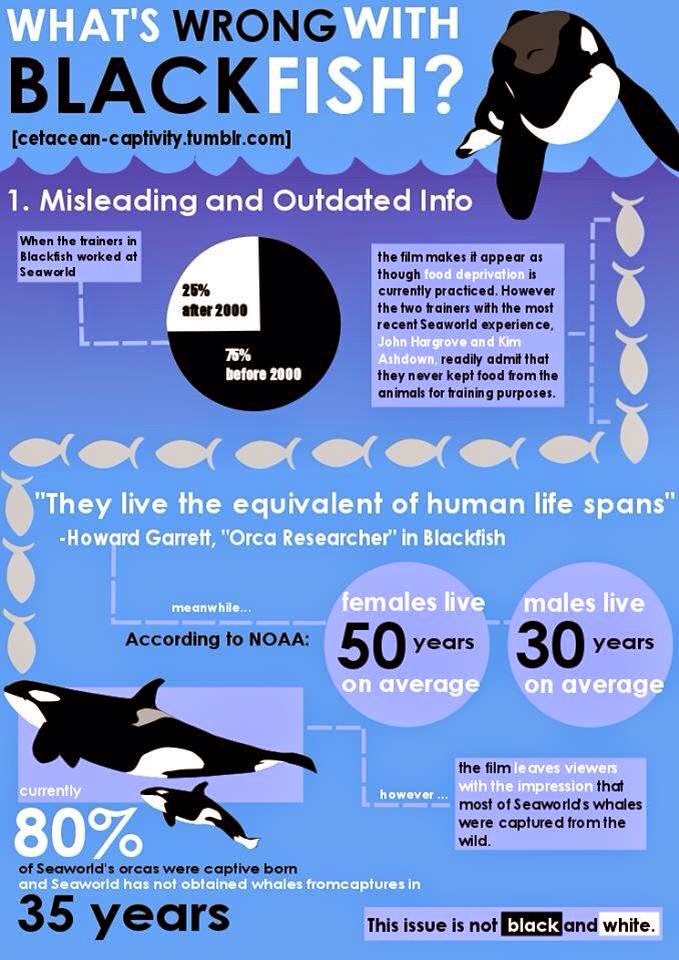
Very little objective analysis by these news outlets as to the accuracy of the information presented within this documentary. Moreover, it is simply not the case that there is no alternative information available as this can easily be found on SeaWorld's supporting web sites and other legitimate sources. These go into a great deal of detail as to why Blackfish should not be viewed as a valid and objective documentary.

With yet another twist and turn in the saga of SeaWorld and its killer whales, it was erroneously announced by both popular and the scientific press that the San Diego Park would be phasing out its killer whale shows in 2016

  In point of fact, this is not exactly what was said at the SeaWorld press conference. The fact that both the mainstream (and even the scientific press) seem completely incapable of reporting anything to do with the whole issue of SeaWorld and its killer whales objectively should be a cause of serious alarm.  What SeaWorld has actually decided to do is to change the format of its killer whale show at San Diego to incorporate a more educational remit rather than the current more theatrical presentations that can be seen at the other two American parks. 

10 October 2015

Killer whales, Politics and Animal-Rights.


I am sure that this animal-rights led pantomime will continue to roll on. Unfortunately, I am minded to think that the only people who will profit from this are lawyers and the least likely are going to be the killer whales and their care at SeaWorld. 


Perhaps it should be a given that politicians should be very wary of getting involved in areas of science where they have very little or no specialist knowledge. This is particularly true in the area of animal welfare – which actually can be considered a science that can be objectively studied. This situation has become even more complex since the inception of the philosophical concept of animal-rights which as many have pointed out bears little relationship to issues of animal welfare.

15 June 2015

John Michel Cousteau Wants To Save SeaWorld. Really?


 "...Marine-animal expert Jean-Michel Cou­steau — who worked on the successful release of Keiko, the star of “Free Willy,” into a seaside pen (before he died in the wild) — said SeaWorld Entertainment can move its orcas to seaside sanctuaries without costing it money.This brief news article is the musings of John Michel Cousteau (the son of Jacques Cousteau) whose organisation Ocean Futures was involved in the release project of "Keiko" the killer whale..."
  
The comments in the above-linked article in the New York Post by Claire Atkinson are of course misleading. Let us make it clear the "Keiko" project was not a success. In making this statement, I mean that the plan to reintegrate this animal back into a population of wild killer whales off the shores of Iceland did not succeed despite huge amounts of time, money and planning. This is not just my opinion this is the conclusion of the peer review paper published in 2009 in the journal Marine Mammal Science HERE.

14 May 2015

Jane Goodall: GMO & Echolocating Dolphins


Her allegation that the sounds the animals produce when using their echolocation bounce back from the walls of their tanks in their exhibits is correct but that is exactly how echolocation works.

Dr Jane Goodall is a scientist who became famous for her research in primatology particularly her work with wild chimpanzees in Africa specifically Gombe in Tanzania when she began her studies in the early 1960s. In 1986,  she published her first major work which was an accumulation of 25 years of original research in The Chimpanzees of Gombe: Patterns of Behaviour. She went on to found the Jane Goodall Institute in 1977 who amongst their mission statements state:

"Improve global understanding and treatment of great apes through research, public education and advocacy"


8 March 2014

Not So Scientific American


The article is jaw dropping in its content and one could be forgiven as not to think this was written by Ingrid Newkirk of the animal-rights group People for the Ethical Treatment of Animals (PeTA).

We live in strange times which have become even stranger if one is to judge by the recent editorial in the journal Scientific American (March, 2014) entitled "Free the Elephants and Orcas in Captivity".

This was an unashamed polemic on 'the rights' of large brained mammals such as elephants and killer whales in relation to their use and display in captive environments such as zoological collections clumsily dovetailed on the back of news of the recent restricting of biomedical testing on chimpanzees in the USA.

29 November 2013

Blackfish: Please Release Me Let Me Go

Up dated: 24 August 2015


On the back of the ongoing debate regarding the film 'Blackfish' The New York Times' produced an interesting video in its Retro Report strand regarding the story of 'Keiko' the killer whale entitled: "The Whale Who Would Not Be Freed". 

The news items conclusion seems to be that the project was a failure.  This is even admitted by some of the supports of the project on video like Naomi Rose - former scientist to the Humane Society of the United States. 

5 September 2013

Cove Cultists?


Yet, it could be a way forward because despite films like 'The Cove' nothing much has changed regarding drive hunts on a local level and animals are still getting killed in large numbers. 

10 August 2013

Blackfish and the Selective Skeptic


Saw Blackfish documentary. Disturbing. It"s time to end exploitation of whales along with chimps. I"m boycotting SeaWorld. Who"s with me?  Michael Shermer, Facebook. 6 August 2013.

22 April 2013

Morgan: No Damsel In Distress


Anyone who begins an article, which compares the slave trade to animals in zoological collections, could be said to be allegedly as morally bankrupt as the suggestion itself: also invoking Godwin's law with comments on Auschwitz are equally repugnant but sadly a disappointing reflection on the calibre of the below cited article. 


6 August 2012

Drive Hunts and Animals Acquired for Dolphinaria.


http://www.ammpa.org/doc_fisheries.html

 
The Cove is the 2009 award-winning documentary exposing the annual drive fisheries hunt of dolphins and whales in the whaling village of Taiji, Wakayama, Japan. 

Drive fisheries are not historically new and several countries aside from Japan also hunt (or have hunted) animals by this method such as the Solomon Islands, the Faeroe Islands and Peru. The drive fishery at Taiji is believed to have been in existence for more than 350 years. The Cove was actually not the first to document this controversial hunt which has been highlighted over the years by magazines such as the National Geographic and in the television series by the late Jacques-Yves Cousteau in the mid-1970s. Many have rightly been very concerned regarding these hunting methods and questioned both its operation on moral, ethical and animal welfare grounds.
However, one aspect of the film that has also proved to be controversial is that in recent years a percentage of animals from this fishery has not been killed but selected for live display in public aquaria and marine parks. In 2007 (the year The Cove was made) official figures show that 13,170 dolphins and whales were hunted and killed in Japan. Of that number 1,239 were hunted in by the drive fishery method and 90 (7.3%) removed alive for aquaria. 

Between the years 2000-2013, a total of 19,092 small cetaceans were taken in the drive fishery at Taiji, Japan. 17,686 of those were slaughtered while 1,406 were taken as live-capture for sale to zoos and aquaria. Graph and data courtesy of Cetbase.

Unfortunately, the makers of the film have taken the position that suggested that this supply of animals to aquaria and parks was the prime purpose of the hunt and that if it ceased so would the hunt itself. This is not surprising as one of the main protagonists in The Cove is animal-rights activist Ric O'Barry who is stridently opposed to dolphins being held in the care of humans in zoological parks. 

Moreover, the film suggests that animals from the hunt are being transported globally to countries such as the USA and that persons visiting these parks are in fact support the killing of dolphins and whales in Japan which is basically untrue. In fact, it should be noted that most of the popular cetaceans held in both the USA (and mainland Europe) are sustained via captive breeding and therefore these populations have no need to acquired animals via live capture operations from the wild. Animals from hunts such as Taiji are generally supplied to aquaria in Asia and the Middle-East and it has recently been alleged that 15 dolphins from a Japanese drive fishery have also been imported into Turkey in 2010.

The Cetabase web site has produced a contemporary map of global facilities that currently house animals derived for drive hunts HERE.

Further, several zoological collections and organisations involved in the captive care of marine animals have made clear statements against drive fishery hunts and consider them inhumane.


Only one drive-fishery animal has until recently been held in the USA. It is a false-killer whale called Kina originally imported by the US Navy's Marine Mammal Program from Ocean Park, Hong Kong in 1987; it was transferred to the Hawaiian Institute of Marine Biology in 2000. This animal was used for research and was not on general public display.  In September 2015 Kina and her two bottlenose dolphin companions were transferred to SeaLife Park in Hawaii. Studies on these animals echolocation and biosonar abilities will continue at the park in partnership with the University of Hawaii. Kina died at Sea Life Park in October 2019.

An attempt to import false killer whales to a US marine park acquired from a drive fishery in 1993 was blocked by the National Marine Fisheries Service as they considered such operations inhumane which has effectively banned further imports of animals into the USA from drive fisheries. 

Animal rights supporters elsewhere have also cited that Sea World in California was granted an import permit for a captive pilot whale from a Japanese aquarium which joined its current group of pilot whales at San Diego on in 2012. It should be pointed out that this animal is an alone stranded animal that was rescued in January 2004 and is deemed unsuitable for release. It should be noted that this animal was not acquired by deliberate capture nor from a drive fishery. 

The two facts anyone who watches The Cove should remember are:
(a) that the drive-fishery in Japan prime motive is 'pest control' and food as the animals are perceived to be in competition with fisherman and that the hunt has been undertaken for hundreds of years and animals for zoos and aquaria are a recent development and the numbers taken are small and if this stopped sadly the hunt would still continue;

(b) that no animals have been imported into the mainland Europe since 1980 and in the US since 1989 from any drive-fishery; the majority of animals displayed in these locations have come from captive breeding programs.
***

 Below a two-part video commentary on the inaccurate statements made by Richard O'Barry and others regarding the Japanese drive fishery and captive cetaceans in aquaria outside Asia and the Middle-East.


Enhanced by Zemanta